 When the Concrete Society published the third edition of Technical Report 34, many people involved in warehouse design, construction and operation welcomed the clarity and practicality of the new floor flatness standards it included.
Previous standards only covered the across-axle tilt measurement and the short wave-length characteristics of the outer two wheel tracks. They did not include measurement of the positions of all wheels or a long wave-length control, and as a result warehouse operators were in the dark over a vital productivity issue. Meanwhile, trucks have been getting faster – up to 11 kph – and lifting to greater heights, so the issue of floor flatness is even more important now in the sense that more productivity is potentially available.
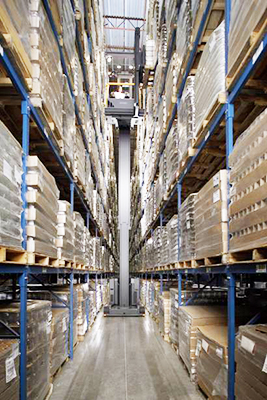 Appendix C of the new edition of TR34 includes maximum values for differences in levels across the aisle and down the aisle for all wheel tracks for VNA installations and also stipulates the rates at which levels change. Values are specified for a range of truck lift heights.
However, confusion remains in the industry about the TR34 floor flatness standards, their merits and how they can be assessed. Some of the confusion may even have been intentional, as various truck suppliers compete for business. Like salesmen everywhere, truck salesmen do not want obstacles in the way such as inconvenient floor specifications.
In order to assess the potential running speeds of floors, operators need reliable data that can relate truck speed to floor flatness with confidence. In this respect, one of the methods most commonly used in the UK for VNA floor measurement is seriously inadequate because the center wheel track is not measured, so the relationship between the rear center wheel and the front load wheels is ignored.
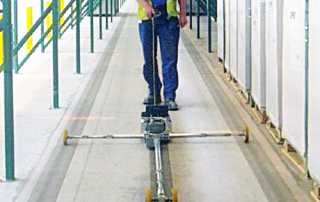
This gap in the data is easily filled by a simple procedure, approved by the TR34 report in 2003 and recently confirmed in a Concrete Society Guidance Note. This involves the use of a truck simulator to measure the floor as the truck would respond to it. The standard ‘profileograph’ (Face floor profiler) used by FACE Consultants in their procedures has one sensor that measures height differences between the front and back of the truck and a second that measures the differences from side to side.
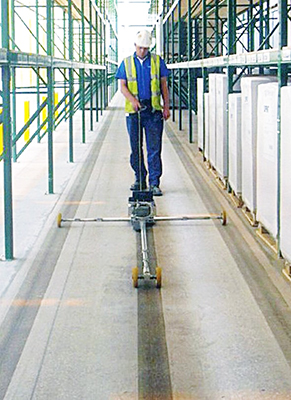 This technique has been used in the USA for 30 years and has been available in the UK for at least the last six years, and a similar method is used in Germany and much of continental Europe. Its use in the UK has increased dramatically. There is no doubt that it gives warehouse operators the information they need to judge whether a floor will allow their trucks to operate at the speeds claimed by the manufacturers and help the productivity levels required in the warehouse to be achieved. In fact, higher truck speeds are only one benefit:
operators will also enjoy lower maintenance costs, less down-time and reduced driver fatigue.
The TR34 Appendix C truck simulator method has been accepted in a draft European Standard.
The best course of action when a new VNA warehouse floor is being laid is to aim for the required flatness standard in the first place and without subsequent grinding. Many
contractors can build to the necessary standard at little extra cost, but it has to be said that some apparently cannot. Floors laid without reliance on grinding will have cross-aisle and down-aisle tolerances in all tracks that are well within the requirements.
It is understandable that some surveying and grinding companies have not taken to the new standards with enthusiasm because they have involved new equipment and new procedures. The coordinated grinding of a moving set of three points is more complicated than simply dealing with only the two points at either side of an aisle.
With existing floors, operators need to get the best out of what they already have. As a starting point, we strongly recommend measuring them using the TR34 Appendix C truck simulator method. Armed with this reliable data, better informed business decisions can be taken about truck purchases, floor upgrades and other options.
In many cases improvements can be made at modest cost simply by attending to lifted joints or other isolated features in racking aisles, the effects of which are only picked up by the truck simulator method. If safety is the only requirement, then the trucks can be slowed down – if that has not already been done.
Please share this story:


